

Good training shouldn't traumatize anyone—but it shouldn't hide the reality of the situation either.
A first aid training course has one clear goal: to help people become more capable of taking action in an emergency —practically, under realistic conditions, and in a way that ensures they not only know what to do when it counts, but can actually do it.
Not just on paper. Not just for a certificate. Not just in a classroom. This article is for companies, clubs, organizations, and individuals who want more than just to fulfill a formal requirement and are looking to build genuine confidence in emergency situations .
Nevertheless, many training programs are heading in a direction that warrants critical review. Out of concern for overwhelming participants, triggering them, or exposing them to unpleasant images or physical strain, much of the content is heavily sanitized. Injuries are shown only as illustrations. The language used is very soft. Real-life scenarios are avoided. Practical elements are reduced. Rescue techniques, lifting, pulling, repositioning, or more physical exercises are sometimes no longer practiced at all for fear that someone might theoretically get hurt.
This is often well-intentioned. But it has a problem.
A real emergency is not airbrushed. A person lying unconscious on the ground does not look like a mannequin in a training room. Severe bleeding does not look like a red mark on a diagram. A patient struggling to breathe does not look like a slide in a presentation. A traffic accident, a workplace accident, or a serious injury is loud, chaotic, emotional, physical, and confusing.
That is exactly why this is about the quality of first aid courses: about realistic practical exercises and scenario-based training, about the sensible use of equipment, about assigning roles in an emergency, about stress management, a culture of learning from mistakes, and about structuring training so that the skills remain accessible weeks or months later.
When training completely ignores this reality, it easily creates a false sense of security. Everything seems fine in the course. Everyone participated. The requirements are met. The certificates are issued.
But the crucial question remains: can the participants really act when it matters most?
Standard training has its place – but it doesn't automatically guarantee the ability to act.
For many people and many organizations, standardized first aid courses are enough. They are affordable, widely available, meet requirements, and provide the necessary certifications. Companies can document that their obligations have been met. Participants complete the course, get their stamp, and return to their daily routine.
That is not inherently wrong. Standardized courses have their place. They create a foundation. They bring first aid knowledge to the masses. Not every company, club, or organization automatically needs high-fidelity scenario training.
But we have to be honest: fulfilling a requirement does not automatically mean that people will function under stress.
A course can be formally correct and still be far removed from what is actually required in a real-life situation. If everything is only discussed theoretically, if exercises remain very superficial, and if participants never really get hands-on, then a problem arises.
On paper, everything looks fine. In reality, perhaps not.
This is often seen with seemingly simple basic measures. The recovery position is practiced, but in an emergency, the head is not tilted back correctly, breathing is not properly checked, or the person is not monitored after being placed in position. Regarding the AED , many know in theory that a defibrillator exists, but not where the nearest one is located in their own workplace. In the case of severe bleeding, some know that they should apply pressure, but not how firmly, for how long, or exactly where. In the event of cardiac arrest, many rely on the assumption that someone will come along who knows how to perform CPR.
That is the real danger: not a lack of knowledge, but a lack of practical ability.
The comprehensive insurance mentality doesn't work in an emergency
In many areas, a kind of comprehensive insurance mentality has developed.
Someone will show up eventually. Help is on the way anyway. The professionals will handle it. That’s what first responders are for. That’s what the AED is for. That’s what the ambulance service is for.
Of course, emergency services, the fire department, the police, and professional structures are crucial. But they aren't there in the first second.
In the event of cardiac arrest, the first few minutes count. With a life-threatening hemorrhage, a patient can quickly lose consciousness and subsequently bleed to death. For an unconscious person with an obstructed airway, simple basic measures can be decisive. The time until professional help arrives is not a passive waiting period. It is first aid time.
Training must prepare you for exactly this time.
This doesn't mean laypeople should become professionals. It means they need to understand their role: personal safety, situational awareness, calling emergency services, simple life-saving measures, hemorrhage control, retrieving and using an AED, patient care, task delegation, and handover.
Anyone trained only to pass a course is not automatically prepared to step into this role in a real emergency.
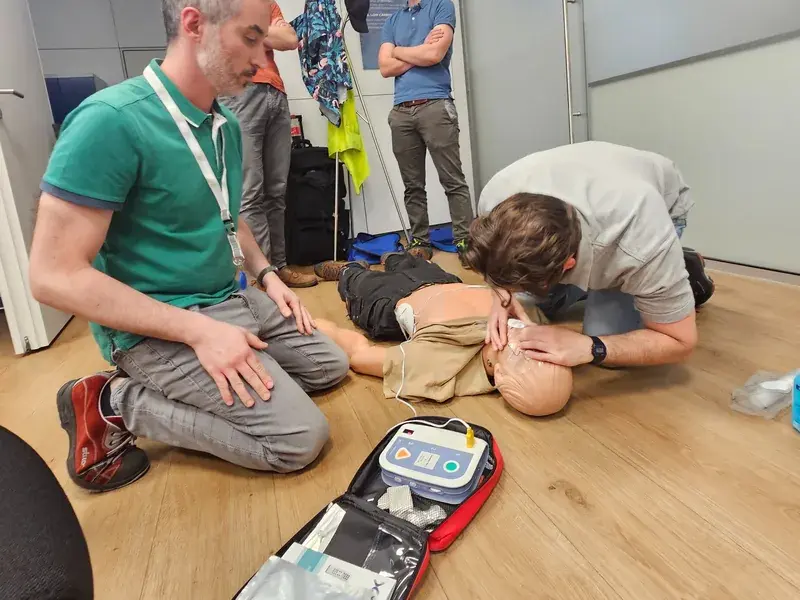
What you don't practice hands-on rarely works under stress
There are tasks you have to grasp – in the truest sense of the word.
You have to get your hands on them. You have to do them. You have to feel what resistance is like, how heavy a body can be, how cumbersome clothing is, how difficult packaging is to open, and how loud and chaotic a group becomes when no one is leading.
Of course, you can explain how to turn a person in theory. You can show a slide on how to apply a bandage. You can show a video of what CPR looks like. You can explain how a tourniquet works. But if someone hasn't even performed a measure practically in a dry, calm setting, it is unrealistic to believe it will suddenly work reliably in a real emergency under stress.
This applies to checking consciousness, checking breathing, recovery position, chest compressions, AED use, pressure bandages, tourniquets, wound packing, rescue carries, repositioning, opening supplies, simulating emergency calls, delegating tasks, and patient contact.
Training that covers all these things only in theory can impart knowledge. But it only provides limited ability to act.
The ability to act is built through practice.
The classroom is not the emergency.
In the classroom, many things are simple. It is bright. It is quiet. The equipment is ready. The instructor explains the exercise. Everyone knows that nothing has actually happened. The mannequin does not talk back. No one is screaming. No one is bleeding. No one is panicking. No one is looking at you in desperation. No one is in the way. There are no bystanders, no relatives, no machinery, no traffic, no noise, no darkness, no cold, no heat, and no unclear situation.
That is important for the beginning. You need a safe learning environment.
But if training stops there, the crucial step is missing.
A real emergency does not take place in a perfect room. It happens where people work, live, drive, hunt, train, travel, or play sports. It happens in workshops, warehouses, offices, stairwells, parking lots, construction sites, vehicles, forests, shooting ranges, clubhouses, or homes—and that is where you need the right first aid and trauma equipment.
Nothing is prepared there.
Good training must therefore build a bridge: from calm learning to more realistic application. Not maximum intensity right away. Not chaotic for the sake of chaos. But gradually moving closer to reality.
Realistic training does not mean overwhelming people.
Realism in training is often misunderstood.
It is not about shocking participants. It is not about putting on a show with fake blood, smoke, screaming, or graphic imagery. It is not about exposing people or disregarding boundaries.
Realistic training must be conducted safely. This includes a clear framework, pre-briefing, adjusted intensity, clear stop signals, psychological safety, skilled instructor guidance, and debriefing.
But training realistically also means not hiding reality completely.
Anyone who has never seen a real injury may freeze up in an emergency. Anyone who has never heard how people can react in crisis situations will be surprised when a patient screams, becomes aggressive, is apathetic, or keeps asking the same question. Anyone who has never practiced under mild stress does not know if they will stay calm, develop tunnel vision, or forget the simplest steps.
Good training prepares you for this. It doses reality in a way that keeps learning possible.
Photos, videos, and real case studies: preparation instead of shock.
Critical Knowledge prefers to work with realistic operational photos, videos, and case studies., provided it aligns with the assignment, the target audience, and the scope.
Not because we want to burden people, but because it makes a difference whether you only know an injury from a drawing or whether you have seen and discussed what a real situation can look like in a safe learning environment.
The classroom is the right place to process such impressions in a calm setting. It is where you can explain what you are seeing. What is important. What is not. What first responders can do. What professionals will take over. Which reactions are normal. Which mistakes are common. Which thoughts help in an emergency.
This can provide psychological preparation. Those who go from a completely sheltered world into a real emergency situation often face a greater internal hurdle. Those who have already worked with such images and scenarios in a controlled training environment are more likely to fall back on something familiar when it counts.
Of course, this requires responsibility. The target audience, context, and reasonableness must be considered. However, removing everything realistic from training across the board also deprives participants of the chance to prepare seriously.
Mistakes in training are valuable
An important part of our training philosophy is: people are allowed to make mistakes during training.
Even more: they should notice where mistakes occur.
Not because we want to expose them, but because mistakes in training are valuable. That is where they can be discussed, corrected, and learned from.
Many perform well in a relaxed classroom setting. This can create a false sense of security. Only when stress factors are added do you see what is truly accessible.
Is the emergency call forgotten? Is breathing checked? Is the AED retrieved? Is someone addressed directly? Is equipment found? Is the patient monitored? Is there enough pressure applied in the case of severe bleeding? Is normal breathing really checked for an unconscious person?
Such points are not identified by listening. They are identified by doing.
In our training sessions, we repeatedly see that participants suddenly become very uncertain in a trauma-related scenario when unconsciousness or resuscitation is added. This is important. Because in reality, an emergency does not stick to the course title.
At the shooting range, someone can become unconscious. On a construction site, a cardiac arrest can occur. During outdoor training, a medical emergency can arise. In a company, in addition to an accident, an internal emergency such as shortness of breath, a seizure, or a circulatory problem can occur.
Anyone who trains for only one scenario is often not prepared broadly enough.
Scenario training shows who can take on which role in an emergency
Another major advantage of realistic first aid training and scenario-based training is the feedback that comes from it.
In a standard course, everyone usually passes. Everyone gets their confirmation, their stamp, or their certificate, and on paper, everything is taken care of. That is organizationally convenient, but it can create a false sense of security. Because passing a course doesn't automatically mean someone will remain capable of acting under stress.
In a well-conducted scenario training, you see more. You see who stays calm. Who can handle the sight of blood. Who takes responsibility. Who can clearly direct others. Who prefers to work in the background. Who organizes equipment. Who gives good briefings. Who is strong with the patient. And who, under stress, perhaps shouldn't be on the front line.
This is not an assessment in a negative sense. It is not about exposing anyone. It is about honestly recognizing strengths and limitations.
Not everyone has to take on the same role in an emergency. Some people are good at working directly with the patient. Others are better at directing emergency services, fetching equipment, securing the area, calming colleagues, or relaying information. These are important tasks, too.
Good training helps to make these roles visible.
For participants, this leads to self-reflection: What am I good at? Where do I feel uncertain? What should I review? How do I react to blood, stress, noise, or time pressure? Should I continue training on my own? Should I discuss what to do in an emergency with my family? Do I even have the right equipment at home, in the car, or on the go?
For employers, team leaders, and safety officers, this also provides valuable insights. They see who is likely to take responsibility in critical situations, who needs extra practice, and who is better suited for a different role.
Especially in higher-risk work environments, this can also be relevant for planning and organization. If a company knows which employees are particularly capable in emergency situations, they can design duty rosters, shifts, teams, or safety concepts more intentionally. Not with the attitude of "someone will help," but with a more realistic picture of the available skills.
That is the difference between a perfect world on paper and genuine preparation.
A scenario-based training doesn't just show whether someone knows a procedure in theory. It shows whether people can take action under pressure. And that is exactly what it comes down to in the end.
Consciously and guided expansion of comfort zones
People don't learn by being overwhelmed. But they also don't learn by having every challenge removed from the training.
That is why we work in stages. Participants are not thrown into an extreme situation unprepared. They are first given the basics, structure, and security. Then, the comfort zone is slowly expanded: more reality, more distraction, more responsibility, more time pressure, more team dynamics.
The word "extreme" is relative here. For some, even approaching an unconscious person is a hurdle. For others, fake blood is unfamiliar. Still others only realize during a resuscitation exercise that they tire physically faster than expected. And some realize during a scenario that while they know a lot under stress, they struggle to communicate.
All these insights are valuable.
Good training creates a framework where people can recognize these limits without feeling ashamed. The question isn't: Who is good and who is bad? The question is: Who can take on which role, what still needs practice, and how can the team become stronger as a whole?
First aid is not an individual competition. It is a team effort.
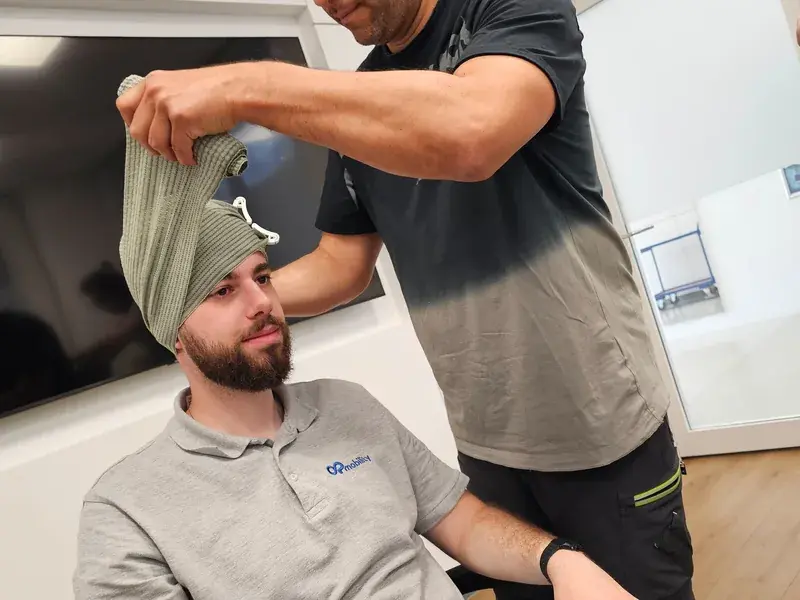
Equipment must be used – not just shown
Another difference lies in how equipment is handled.
In many training sessions, equipment is shown, explained, and perhaps passed around once. That is a start. But it is not always enough.
Anyone expected to apply a bandage in an emergency should have opened bandages before. Anyone who owns a tourniquet should have practiced applying it. Anyone expected to work with an AED should have operated a training device. Anyone who needs to expose a wound should understand why standard trauma shears are not always sufficient. Anyone who wants to learn wound packing must practice it hands-on.
In scenario-based training, we therefore do not prioritize preserving equipment in the wrong way. If it fits the training, the equipment gets used. Packaging is opened, bandages are applied, clothing is cut, fake blood is used, and simulated wounds are treated. Participants are welcome to bring extra clothing that can be cut or soiled.
This costs more. But it creates a different level of learning.
An unopened bandage on a table creates knowledge. A bandage applied to a person under time pressure creates experience.
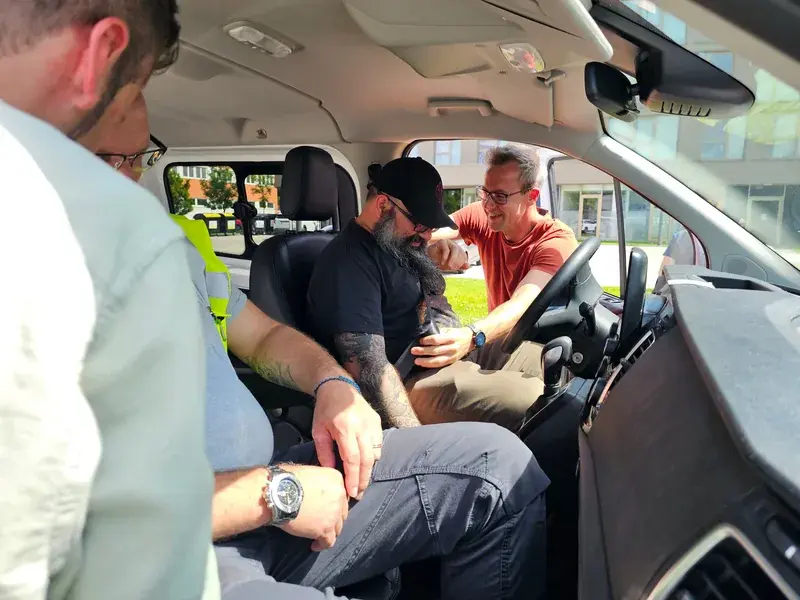
Scenario-based training brings first aid to life
Scenario-based training is not necessary for every course. But where you want to achieve genuine confidence in your actions, it is incredibly valuable.
A scenario brings several things together: situation, stress, equipment, communication, patient contact, responders, mistakes, time pressure, and debriefing.
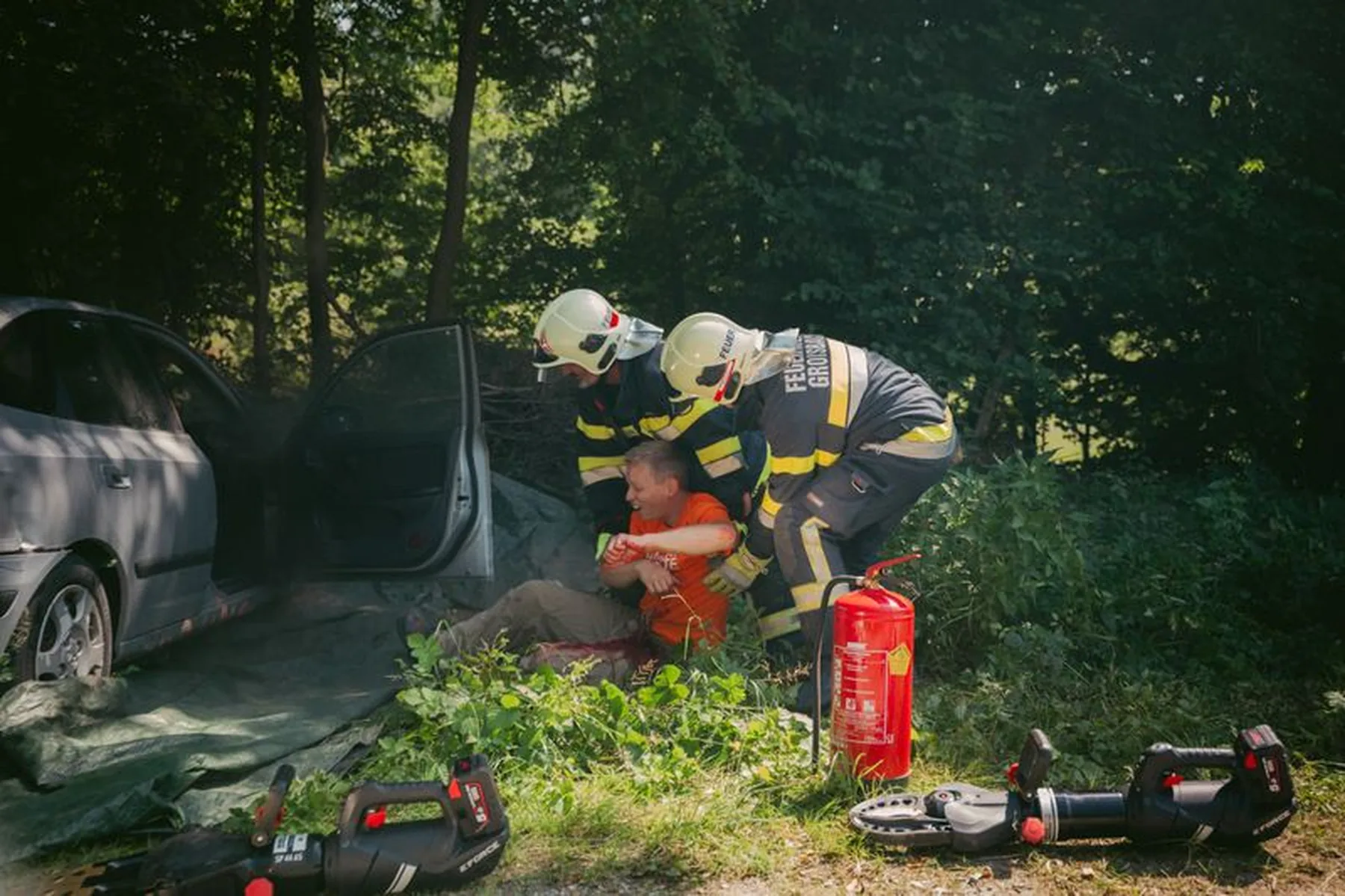
Depending on the assignment and the possibilities, we work with fake blood, moulage, simulated wounds, actors, smoke, fog, artificial fire, or other elements, especially in formats such as the Stop The Bleed hemorrhage control course. In specific settings, we can also incorporate amputee actors or more elaborate operational simulations.
But the same rule applies here: it is not a show.
The goal is not to create a spectacular image. The goal is learning.
A good scenario answers questions that often remain open in a standard course: Who takes the lead? Who calls emergency services? Who speaks to the patient? Who identifies the danger? Who retrieves equipment? Who coordinates other helpers? Who notices that there is a second patient? Who breaks down under stress? Who stays calm? Who needs more practice?
The scenario is followed by a debriefing. That is where the real value lies. You don't just discuss what went wrong, but why it happened and how to do it better next time.
That is more sustainable than any slide.
Tailor-made instead of off-the-shelf
Critical Knowledge is often booked by companies, clubs, and organizations that want more than the minimum standard and a 16-hour first aid course for businesses in Austria | On-site format.
This does not mean that every training session has to be maximally intense. It means that every training session should fit the mission.
Before starting projects, we talk to those in charge: What is the goal? What can the participants handle? What are the risks? What prior experience do they have? What materials are available? What emergency procedures are already in place? What tone is appropriate? What are the boundaries? How realistic should the training be? Which scenarios make sense?
We usually find that clients place a great deal of trust in us. They don't want their employees to just sit through a session. They want them to be able to truly practice. They want to know what works and where the gaps still are.
That is the difference.
A sophisticated client doesn't just book a course. They book a learning process.
Emotional learning sticks better
People remember experiences better than slides.
A pure PowerPoint presentation can convey information. But information disappears quickly if it is not applied, repeated, and linked to meaning.
Active learning, practical exercises, repetition, emotional involvement, and reflection create a different effect. When someone has performed a procedure themselves, when they have felt a situation, when they have made a mistake and understood it, when they recognize their own reaction during the debriefing—that is when it really sticks.
This is especially important in first aid.
Because in an emergency, nobody pulls up a slide.
You pull up actions. Images. Procedures. Phrases. Physical intuition. Training experience.
That is exactly why we want to design training sessions that leave an impression. Not traumatizing. Not overwhelming. But relevant enough that participants can later say: "I know what this is about. I've done this before. I can get started."
Good training also shows limitations
A good first aid training should not send participants away with a false sense of confidence.
It should make them more capable of taking action – while simultaneously showing them their limits.
Not everyone is suited for every measure. Not everyone stays calm in every situation. Not everyone can perform physically demanding tasks. Not everyone is comfortable working with significant bleeding. Not everyone is immediately resilient in a scenario. That is perfectly fine.
But it is better to recognize these things during training than in a real emergency.
This is valuable for companies, clubs, and organizations. You see who is strong in which role. Some are good with the patient. Some organize equipment. Some keep an overview. Some are good at directing others. Some calm others down. Some need more practice.
This creates a realistic picture of your own resources. Not everyone has to be able to do everything. But a team should know who is good at what and where gaps still exist.
Transferring skills to everyday life, family, and leisure
A good first aid training does not end at the company gate.
Many participants take something away for their private lives. They start thinking about whether they have a sensible first aid kit at home. Whether there is equipment within reach in the car. Whether their family knows what to do in an emergency. Whether at least basic medical planning is in place for vacations, mountain hikes, sports, club activities, or travel.
That is an enormous added value.
Because emergencies don't just happen at work. They happen at home, on the road, during sports, on vacation, at clubs, at events, or among friends.
If training inspires people to take responsibility even when they are off the clock, then it has been truly sustainable.
Why Critical Knowledge trains workplace first responders differently
Critical Knowledge intentionally takes a different approach.
We don't just want to churn out certificates. We want to empower people to take action.
This means we work in a way that is practical, realistic, and tailored to the target audience. We coordinate with clients to determine the scope of the training. We use real-life case studies, images, scenarios, and equipment wherever it is sensible and appropriate. We get participants actively involved. We let them make mistakes in a safe environment. We discuss those mistakes. We motivate them to take responsibility.
That is why our training may cost more than a bare-minimum program. But it is also designed differently.
Not as a box-ticking exercise. Not as a PowerPoint presentation. Not as a certificate factory.
But as an investment in confidence in action.
For employees. For clubs. For teams. For families. For everyday life. For the workplace. For emergencies.
What good first aid training should achieve
Good training must be technically accurate. It must be safe. It must align with the legal framework. It must treat participants with respect. But it must also be effective.
Effective means: participants should be able to do more afterward than they could before. They shouldn't just know what was on a slide. They should have experienced a procedure in practice. They should know where their uncertainties lie. They shouldn't be seeing equipment for the first time in an emergency. They should understand that the first few minutes are what count.
This doesn't always require high-end simulation. But it does require honesty.
If a course is just pleasant, smooth, and abstract, it might be easy to consume. But the question is whether it prepares you for what could actually happen.
Good First aid training doesn't have to be comfortable. It needs to be safe, responsible, and effective.
The bottom line: Train for reality, not for the certificate.
First aid training shouldn't overwhelm people. But it shouldn't leave them in an artificially sanitized world, either.
A real emergency isn't abstract. It’s physical, emotional, chaotic, and sometimes distressing. That is precisely why training must responsibly bring people closer to that reality.
Standard courses fulfill their requirements and have their place. But if you want more than just a certificate, you need more: hands-on repetition, authentic equipment, realistic scenarios, stress factors, a culture of learning from mistakes, debriefing, and sustainable learning. A basic course of 16 hours is required for workplace first responders, for example.
Because in an emergency, it doesn't matter if all the boxes were checked on paper.
What matters is that someone takes action.
First aid is not a game. The goal is to save lives, preserve quality of life, and bridge the time until professional help arrives as effectively as possible.
When you only have a few hours with a group to achieve this, you should make the most of that time. In Austria, such courses typically last between 6 and 16 hours. A first aid training usually lasts 16 hours. For a driver's license, the course covers 6 hours. This applies to obtaining licenses for classes A, B, C, and F. A refresher course can last 4 or 8 hours. A first aid refresher course is legally required every 4 years. In practice, such formats are often recommended every 2 to 4 years. These refreshers are legally recognized in accordance with § 26 ASchG. In Vienna, they are sometimes offered in a hybrid format with online theory components. The focus is often on cardiopulmonary resuscitation. The “First Aid for Children” course lasts 16 hours. Participants learn cardiopulmonary resuscitation for children. Emergencies such as airway obstructions and poisoning are also covered. Not through unnecessary harshness, but through consciously guided, well-structured training that expands the comfort zone and brings people closer to reality, step by step.
Anyone who first aid seriously doesn't train just to get a stamp.
They train for the moment when someone truly needs help.
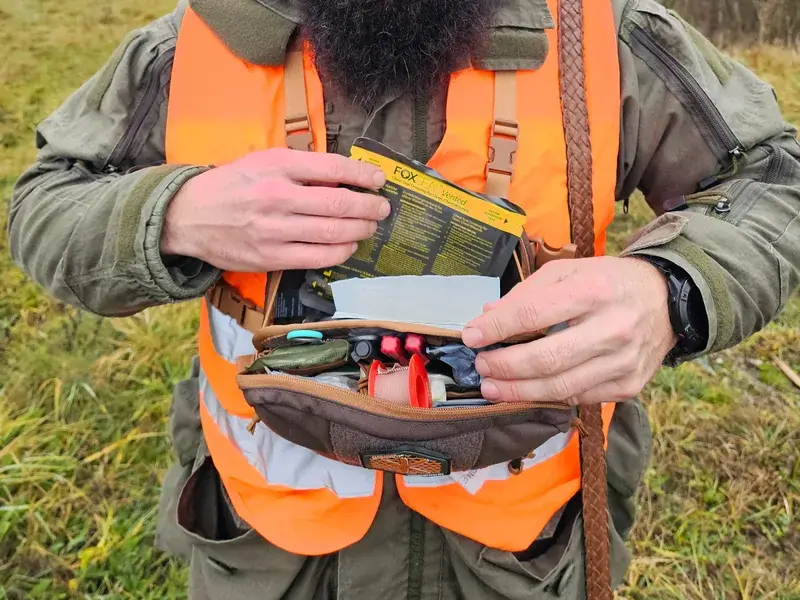
Our recommendation
If you want first aid training that does more than just tick a box: Request corporate training.
If you want to plan realistic scenarios for your company, club, or organization:Discuss scenario training and other courses.
If you want to get hands-on training for life-threatening bleeding: Book a STOP THE BLEED® course.
If you want to become more capable in general: Check out Active Life Saver.
Button-CTA: Request training Second CTA: Plan scenario training Third CTA: Book a STOP THE BLEED® course
Sources and professional classification
Austrian Labour Inspectorate: Workplace first aiders, training and refresher courses.
DGUV: Workplace first aiders and further training.
European Resuscitation Council Guidelines 2025 / First Aid: First aid, life-threatening bleeding, direct pressure, dressings, wound packing and tourniquet depending on the situation and training.
Freeman et al., PNAS 2014: Active learning increases student performance in science, engineering, and mathematics.
Critical Knowledge training philosophy: practical, scenario-based, target-group-oriented and action-oriented.
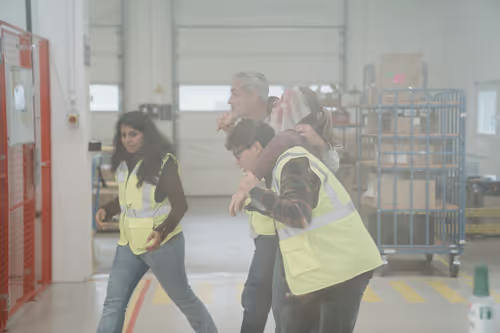
Request a realistic simulation
Transform your emergency training with realistic wound simulations and scenarios to create an intensive and effective learning experience for your team.
Discover our trauma kits
Purchase premium trauma kits, including tourniquets, bandages, and other essential materials for emergencies in challenging environments.
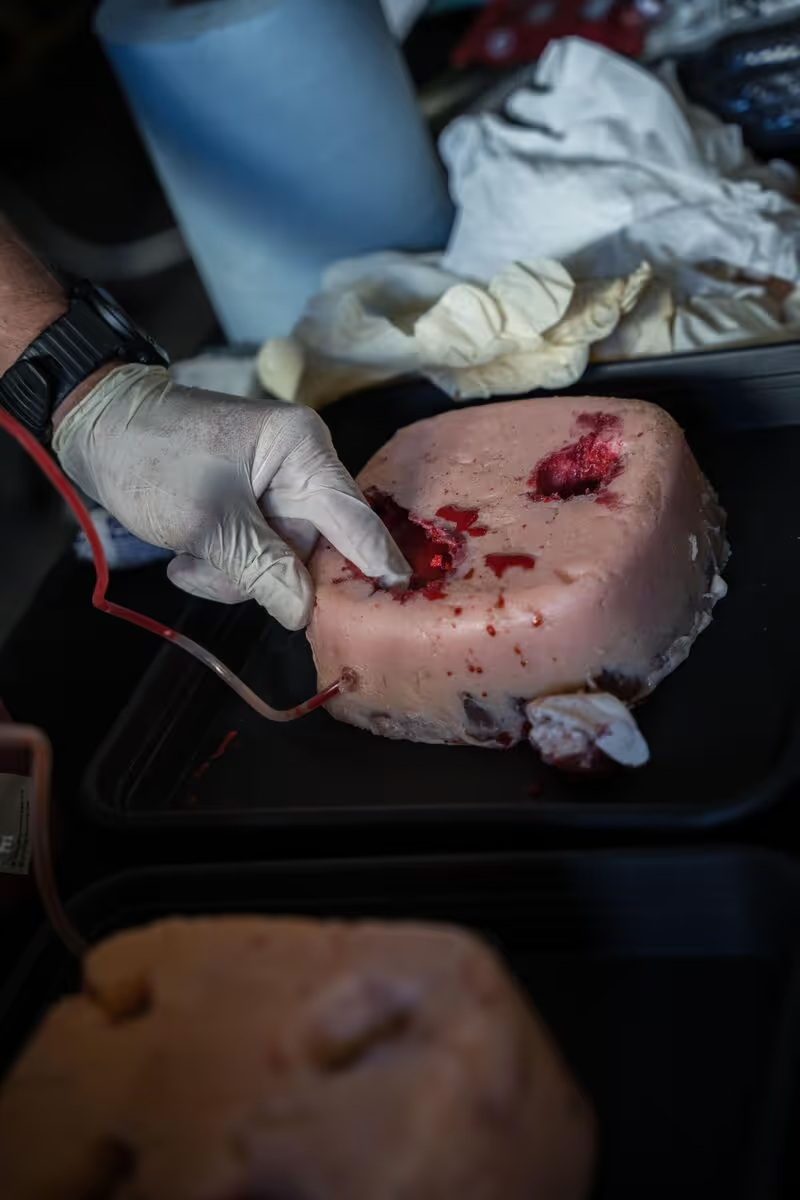
Book your first aid course
Prepare your team for critical situations with hands-on training and real scenarios. Learn how to react quickly in emergencies.

.avif)
.avif)