

Active First Responder B (AFR-B) — Advanced Trauma Care & Scenarios
Level B | Advanced | Prerequisite: AFR-A
%20(2).avif)
.avif)

Description
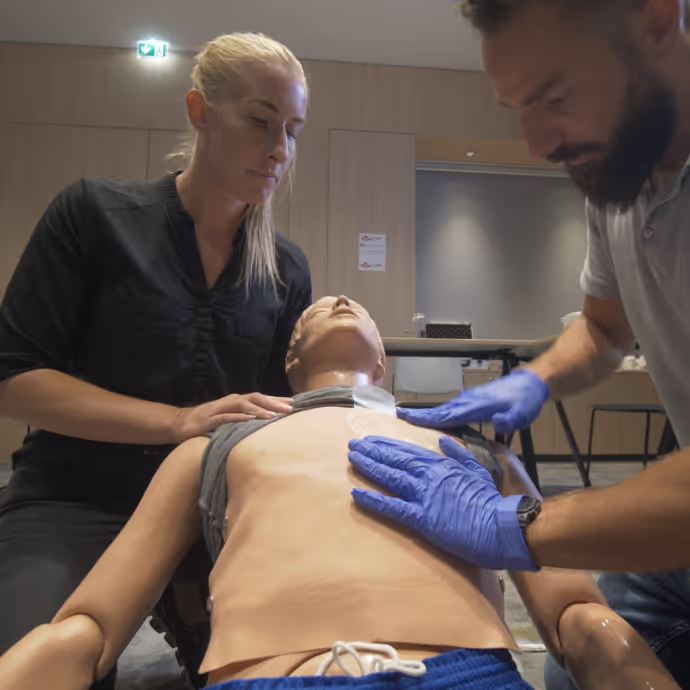
The Active First Responder — B course (AFR-B) builds on the AFR-A on and deepens knowledge in the extended First aid. In this Intensive training Do you learn how to identify life-threatening injuries, prioritize them and hand them over to the Ambulance service to supply. The course focuses on life-saving measures, teamwork and dealing with emergencies.
This course is especially for First aider into undertakings, schools and for private individuals important in order to be able to act quickly and competently in an emergency. The training also includes structured care for multiple injuries and practical scenario training with realistic disruptive factors.

The course includes:
- Workshop participation certificate
- all training materials used
- Using training dummies and wound simulators
- Rental and medical devices for training
In principle, our workshops and courses are held in the Wiener Neustadt area in Lower Austria. For group bookings of more than 10 participants (e.g. associations, companies, closed companies, etc.), we are also happy to come to you with all training materials after personal consultation.
Locations in Austria:
- Focus Range Traiskirchen
- Shooting Park Leobersdorf
- Steyr shooting center Wr. Neustadt
- Waffen Falch St. Anton
- Caliber S Graz
- Shooting Range North Vienna
Target group
The course is aimed at: People who have already completed Active First Responder — A First aiders who want to realistically train trauma care People who want to be able to do more than classic first aid in emergencies, this course is particularly suitable for first aiders and employees in companies, schools, educational and care facilities as well as for anyone who works with children or groups in need of protection. First aid training is particularly important for people working in such environments in order to be able to provide quick and qualified assistance in an emergency.
What you can really do after the course
The aim of the AFR-B course is to give participants maximum security in order to act in a structured and efficient manner in the event of serious injuries. For this, it is essential to have the necessary knowledge to be able to react appropriately and safely in emergency situations.
The guiding principle is:
“Treat first what kills first. ”
Before first responders take action, they must carefully review the situation and surrounding area for safety and take care to protect themselves and others. You learn how to correctly classify drama-looking injuries and, in particular, truly life-threatening injuries quick to identify and treat.
Bring along
Please bring along:
- the same equipment as in the alpha courses
- In addition, several pieces of clothing that can be practiced
- Clothing that can be cut up (training purpose)
Note: Artificial blood cannot be completely removed from some materials.
Lesson modules
At the beginning, the content of the alpha courses is repeated and deepened. The focus is on wound care, bone fractures, burns, cardiopulmonary resuscitation and the safe use of AED. Practical exercises prepare participants for emergencies. Die First aid training must be refreshed every two years and lasts 9 lessons in one day.
Objective: Security in the foundations before complexity is increased.
- Review of AFR-A core content
- Deepen the March/XABCDE principle
- Self-protection & situation assessment under stress
- “Treat first what kills first” — prioritization in practice
- Failure analysis from typical first aider situations
👉 Focus: speed + structure + decision quality
Objective: Controlling life-threatening bleeding in complex situations.
- Tourniquet repeat (single & double application)
- Woundpacking for deep or hard-to-reach injuries
- Junctional bleeding — limits of first aid
- Pressure bandage under difficult conditions
- Wound care for head injuries
- Secondary control (detect re-bleeding)
👉 Focus: Ability to act in case of heavily bleeding, multiple injuries
Objective: More than just “stop bleeding.”
- Detecting unstable fractures
- Immobilization & improvisation in the field
- Correctly assess burns (degree & extent)
- Detect inhalation trauma
- Assess pain & stress response
- Care in case of fall, work or leisure accidents
👉 Realistic scenarios from work, school, outdoor & everyday life
Objective: Safely manage cardiovascular emergencies.
- High Performance CPR
- Team resuscitation (distribution of roles)
- AED integration into dynamic scenarios
- Respiratory security in a First Responder framework
- Post-resuscitation management to emergency services
👉 Training with disruptive factors (noise, time pressure, multiple patients)
🔥 THAT is the real extension to AFR-A.
Objective: Prioritize multiple injured people at the same time.
- Get an overview
- Primary & secondary triage (first responder level)
- Set priorities for several people affected
- resource management
- Team communication
- Handover to emergency services
👉 Scenarios:
Work accident, traffic accident, school accident, outdoor group
trainers
.avif)
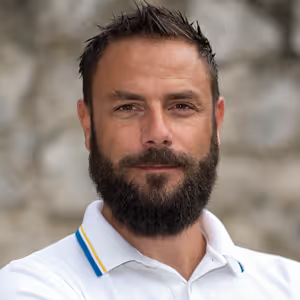
17 years of experience as a Master Medic in the Austrian Armed Forces. During his career, Johannes has trained and coordinated rescue teams in various high-risk scenarios and has developed into a specialist in saving lives in challenging environments.

8
hr
eigenes
Train as you fight! Learning with realistic wounds
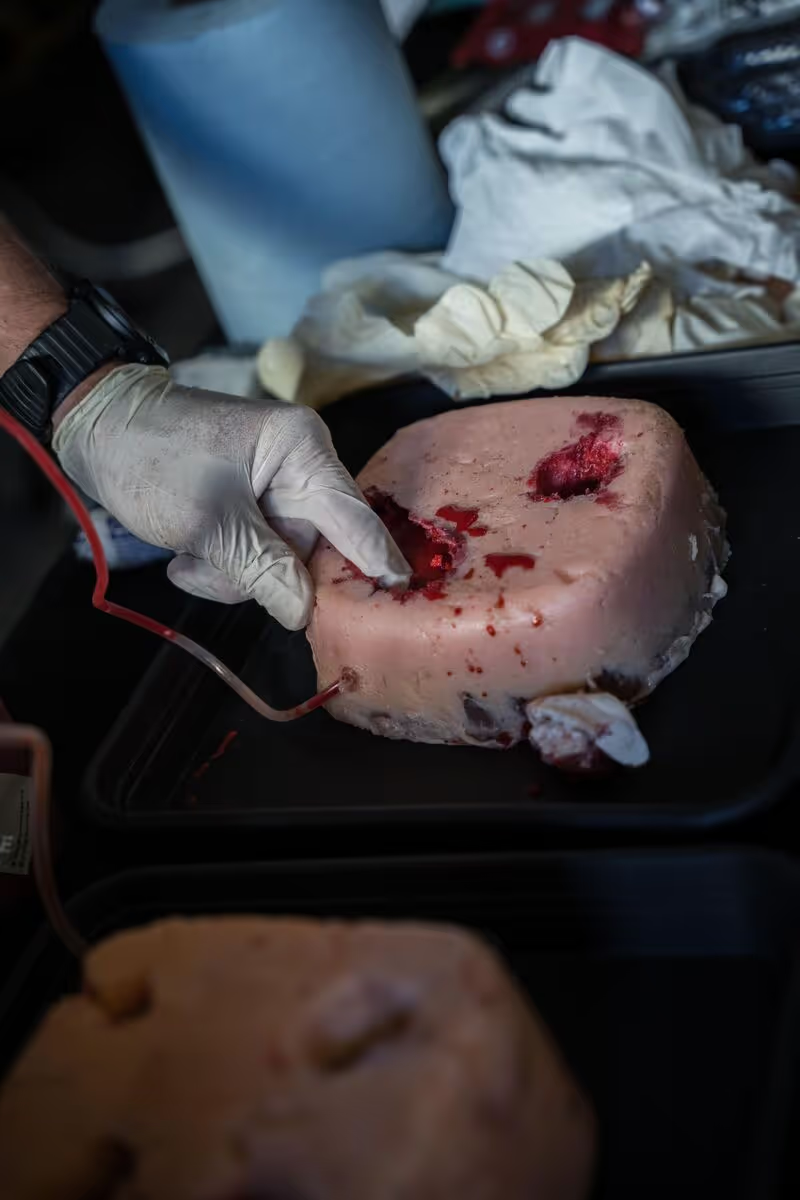

Realistic wound simulations

Psychological preparation
Equipment and special effects

Different scenarios
Frequently asked questions (FAQ) — short & clear
No The Active First Responder — A This is a prerequisite, as the AFR-B requires a lot of content and only briefly repeats it.
Yes The course consists of lots of practice, technical training and intensive scenario training.
Yes Wound simulators and artificial blood are used to make the situations realistic.
Bereit, Leben zu Retten?
Einzelbuchung

Gruppenbuchung
Recommended equipment from our trainings

What our participants say
.avif)
It was really realistic, at eye level, explained simply and practically, we were allowed to try and do everything and also use new materials every time and thus practice (fully equipped) in these special scenarios.
... not just PowerPoint, puppet and theory as usual.
It is really recommended for everyone!
Thanks Hans!!!


We are certified by: