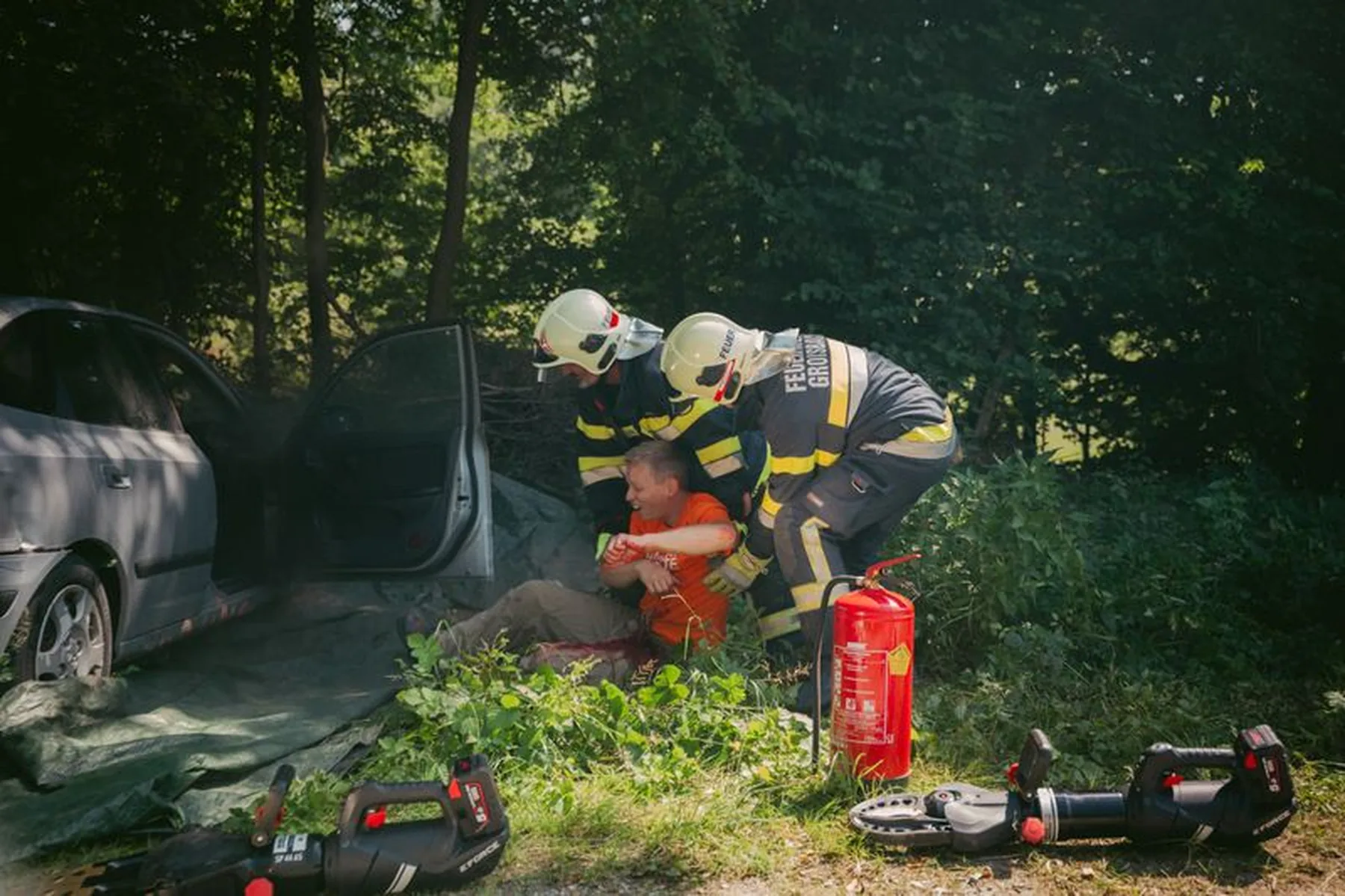

When an incident occurs in a production facility, the binder in the office doesn't matter.
Production facilities are not sterile learning environments.
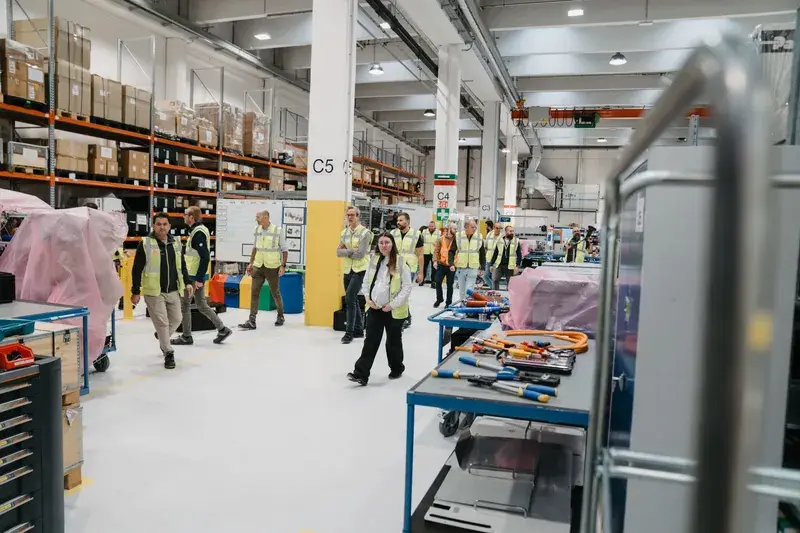
They are loud, sprawling, technically complex, and often organized in shifts. There are machines, forklifts, chemicals, heat, noise, confined spaces, heavy components, contractors, visitors, multiple halls, access controls, plant security, internal alarm routes, and sometimes an on-site fire department. This is precisely why implementing effective first-aid measures in production facilities is critical. First aid in these environments means more than just designated first responders and stocked first-aid kits: what matters are functional emergency procedures, realistic scenario training, and a rescue chain that works reliably under actual operating conditions.
On paper, everything can look perfect in such facilities.
The first responders are appointed. The first-aid kits are in place. The AED is hanging somewhere. The escape routes are marked. The assembly point is defined. Training sessions have been conducted. The emergency plan is in the system.
But the crucial question is not whether these structures exist.
The crucial question is:
Do they work when something actually happens?
This is rarely revealed in a standard training course. It is revealed in a scenario. For business owners, safety specialists, HSE managers, plant security, on-site fire departments, rescue organizations, as well as managers and team leaders in production facilities, it is therefore not about formal compliance, but about genuine operational readiness in an emergency.
Because scenario training brings to light what often remains invisible in tables, training sessions, and certificates: Who takes the lead? Who finds the equipment? Who calls whom? Who opens the gates? Who guides the rescue services? Who knows where the stretcher is? What happens during a shift change? Who looks after the injured at the assembly point? And does anyone even know if there are still people in the danger zone?
These are not theoretical questions.
These are questions that, in a real emergency, can determine time, order, safety, and, in the worst case, life and quality of life. This article highlights typical weaknesses in first aid within production facilities, the practical implementation of emergency organization, and the role of equipment management, reporting chains, guiding emergency services, self-protection, team coordination, as well as practical exercises and external support.
Meeting requirements does not automatically mean being ready for action.
In many companies, first aid is organized based on minimum requirements. This is understandable. Regulations must be met. First responders must be available. Equipment must be ready. Refresher courses must be documented. Audits, inspections, and safety briefings require proof.
That is important.
But it is only the foundation.
A production facility that only ensures everything is formally compliant may still have significant gaps in its actual emergency response capability. Because the reality of an emergency cannot be fully captured in a posted notice.
An employee falls in the hall. A colleague gets trapped. A person collapses during the night shift. During an evacuation, people get injured on the stairs. Smoke or fumes make an area inaccessible. A visitor is missing. A first responder is sick, on vacation, or affected by the incident themselves. The equipment is in the evacuated part of the building. The ambulance service is at the wrong gate.
Such things do not happen because companies are poorly organized. They happen because emergencies are always more complex than the plan.
That is why it is not enough to simply ask: "Do we have first aiders?"
The better question is:
Can our facility bridge the first few minutes of a real emergency in a structured way?
Shift work: First aiders must be where the risk is
One of the first vulnerabilities in manufacturing facilities is the distribution of first aiders.
On paper, the number of first aiders might look sufficient. In reality, you have to look closer. Who is present on which shift? Who works in which area? First aiders must be available in sufficient numbers throughout the entire working day, as an adequate number of first aiders is necessary to ensure employee safety. Who is regularly on vacation, away on assignment, sick, in meetings, or in other parts of the building? Are there areas where there is less staff at night? Who is actually available when external contractors are on-site?
Especially in shift operations, the scheduling of first aiders should not be left to chance.
It is not just about having enough names on a list. It is about ensuring that in every relevant shift, in every critical area, and in relation to the people who are regularly present at the same time, there are people on-site during higher-risk activities who can truly take action in an emergency.
In this context, it can be useful to specifically involve individuals with prior experience in practice-oriented first aid and trauma training . Employees with a background in the fire department, emergency medical services, the military, police, disaster relief, or other emergency organizations often bring more to the table than just basic first aid skills. They may have experience with drills, operations, stress, structure, communication, and leadership.
This is valuable for the company.
Not because these individuals should automatically take over everything. But because in a chaotic situation, they are often better at quickly identifying roles, delegating tasks, maintaining calm, and structuring a rescue chain; this distribution also requires a clear organizational policy for each workplace.
Scenario-based training quickly reveals who takes the lead in such moments—and who might be better suited to taking on a different important task.
Not everyone has to be a first aider—but everyone must be able to help
In manufacturing facilities, a dangerous mindset persists:
"That's what we have first aiders for."
That is only partially true.
Of course, workplace first aiders are important. But in the event of larger incidents, multiple casualties, evacuations, smoke development, or unclear situations, a few people are often not enough. First aiders may be occupied with a patient. They cannot simultaneously fetch equipment, open gates, direct emergency services, manage the assembly point, calm colleagues, relay information, and check for missing persons.
That is why a facility needs more than just a list of first aiders.
The entire team needs a basic understanding, which can be a legally recognized 16-hour first aid course structured to provide.
Not every employee needs to master specialized measures. However, everyone should know how to call for emergency services, where to find first aid supplies, where the AED is located, where assembly points are, how to take on a specific task, and when personal safety is more important than blind action.
This is especially true for international teams.
You should not automatically assume that all employees have the same level of first aid knowledge. In some countries, first aid requirements for driver's licenses or vocational training are regulated differently than in Austria or Germany. For safety specialists, HSE managers, and leaders, this means: the actual level of knowledge within the team should not be assumed, but rather occasionally verified and standardized.
A shared minimum understanding in the workplace is not bureaucracy.
It is part of the chain of survival.
First aid equipment: Supplies that no one can find are worthless in an emergency.
Another classic issue: equipment is available, but not practical for use.
Perhaps there are first aid kits, AEDs, stretchers, rescue sheets, eye wash stations, additional supplies, or a trauma kit. First aid kits must be standardized and kept in easily accessible locations. Everything might be compliant, labeled, and documented. But do the employees really know where it is?
Not just the first responders.
Everyone.
Because in a real scenario, this is often exactly what happens: the first responder stays with the patient. Another person is sent to get supplies. And suddenly, the search begins.
Where is the nearest first aid kit? Which one is the right one? Is the AED in this hall or in the entrance area? Is there a stretcher? Who has access to the supply room? Is the gate locked? Can the first aid kit be taken to the assembly point? Is the additional equipment known, or is it just sitting somewhere in a cupboard?
Equipment must not only be present. It must be accessible, known, complete, clearly marked, and integrated into workflows.
In manufacturing plants, it can also be crucial to consider where equipment is located throughout the facility. A first aid kit in the office is of little help if the accident happens in a distant hall. An AED in the administration building is good, but perhaps too far away in an emergency outdoors. Stretchers are important, but only if someone knows where they are kept and how to use them.
A scenario reveals these gaps without theoretical discussion and highlights how important ready-to-use first aid and trauma equipment is in the right places.
It’s easy to see.
Access and guidance: Emergency services need to reach the patient
Many companies underestimate how difficult access can be for external emergency responders.
Those who work on-site every day know the routes. Emergency services, the fire department, or paramedics usually do not. A large factory site, multiple gates, building numbers, access cards, barriers, construction sites, blocked paths, truck traffic, or internal security zones can cost precious minutes.
That is why guidance must be planned and practiced.
Which gate is designated for emergency responders? Who opens it? Who waits there? Who leads the emergency teams to the patient? Which access route is suitable for large vehicles? Which areas are critical in the event of hazardous materials, smoke, or machine downtime? Who provides the information? Who coordinates with plant security, the company fire department, or reception?
A good emergency call alone is not always enough. The emergency services must be able to find the patient.
Scenario training often reveals that while companies have defined an emergency number, internal guidance does not function smoothly. The patient is being treated while the rescue team is waiting outside or is at the wrong part of the building.
This is avoidable.
But only if you think it through and practice it beforehand.
Reporting chain: Who needs to be notified and when?
An emergency in a production facility rarely affects only the patient.
Depending on the event, several departments must be informed: direct supervisor, safety officer, plant security, company fire department, reception, maintenance, shift supervisor, HSE, management, occupational health, crisis team, communications, or external emergency organizations.
The question is not just who is informed.
The question is how quickly, via which channel, and with what information.
Especially during larger incidents, a clear reporting chain is essential. It protects other employees, prevents rumors, supports emergency responders, and enables internal crisis communication. It also helps prevent sensitive information from leaking out uncontrollably.
In practice, this is often more difficult than planned.
One employee calls emergency services directly. Another informs the shift supervisor. Plant security knows nothing yet. The company fire department is alerted later. Management finds out through third parties. At the same time, colleagues are already sending messages to the outside world.
This is not done with bad intentions. It is stress.
That is why clear procedures are necessary.
And these procedures must be practiced.
Evacuation: Care is not automatically guaranteed once outside
During an evacuation, the priority is understandably to get people out of the danger zone first. That is correct.
But an evacuation does not end the first-aid situation.
On the contrary: sometimes the next challenge only begins once you are outside.
People can sustain additional injuries during an evacuation. They may fall on stairs, bump into things, panic, inhale smoke, or come into contact with hazardous substances. In production areas, laboratories, or technical facilities, secondary incidents can occur: smoke development, toxic fumes, collapsing structures, chemical spills, poor visibility, or blocked escape routes.
Furthermore, the next question arises immediately at the assembly point:
Is there first-aid equipment available there?
Exercises repeatedly show that while injured people are brought out of the building, the equipment is left behind in the evacuated area. First responders and colleagues then find themselves outside with a patient but without a first-aid kit, blanket, AED, or stretcher.
Therefore, a company should consider whether equipment is available at assembly points or in safe areas, or whether—if safe and organizationally feasible—first-aid supplies should be carried out during an evacuation.
This is not just a detail, either.
It is the difference between "we have evacuated" and "we can continue to provide care."
Who is still missing?
One of the most difficult questions during major incidents is:
Is everyone out?
On paper, it sounds simple. In reality, it is often one of the greatest challenges.
Employees are on different shifts, in different areas, or in break rooms. Contractors are working in the building. Visitors are registered, but perhaps not properly signed out. Day guests were brought along by a department. One person has briefly left the premises. Another is in an adjacent area. Electronic access systems are not always immediately available, especially if the affected area has been evacuated or if systems fail.
In a real-life incident, this creates uncertainty.
Is someone still inside? Who knows? Who checks? Who reports it to the fire department? Who has the current attendance information? What happens with visitors and contractors?
Scenario-based training can expose this vulnerability. It shows whether the company only knows who is present in theory, or whether this information is truly available and usable in an emergency.
For safety professionals and managers, this is a particularly critical point because it goes far beyond standard first aid. This is where occupational safety, access management, fire protection, plant security, crisis organization, and the chain of rescue converge, each relying on appropriately organized accessories for emergency and response equipment .
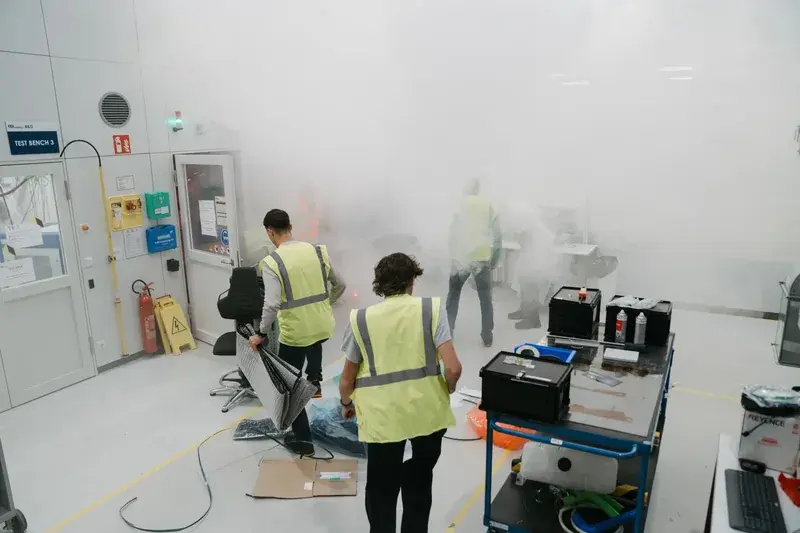
Hazardous substances, smoke, and self-protection: Not every rescue is immediately possible
In manufacturing facilities, there are situations where the desire to help can become dangerous.
Smoke, toxic fumes, chemicals, unknown substances, electrical hazards, moving machinery, hot surfaces, or unstable structures can put first responders themselves at risk. Dedicated employees, in particular, are at risk of entering a situation they cannot accurately assess.
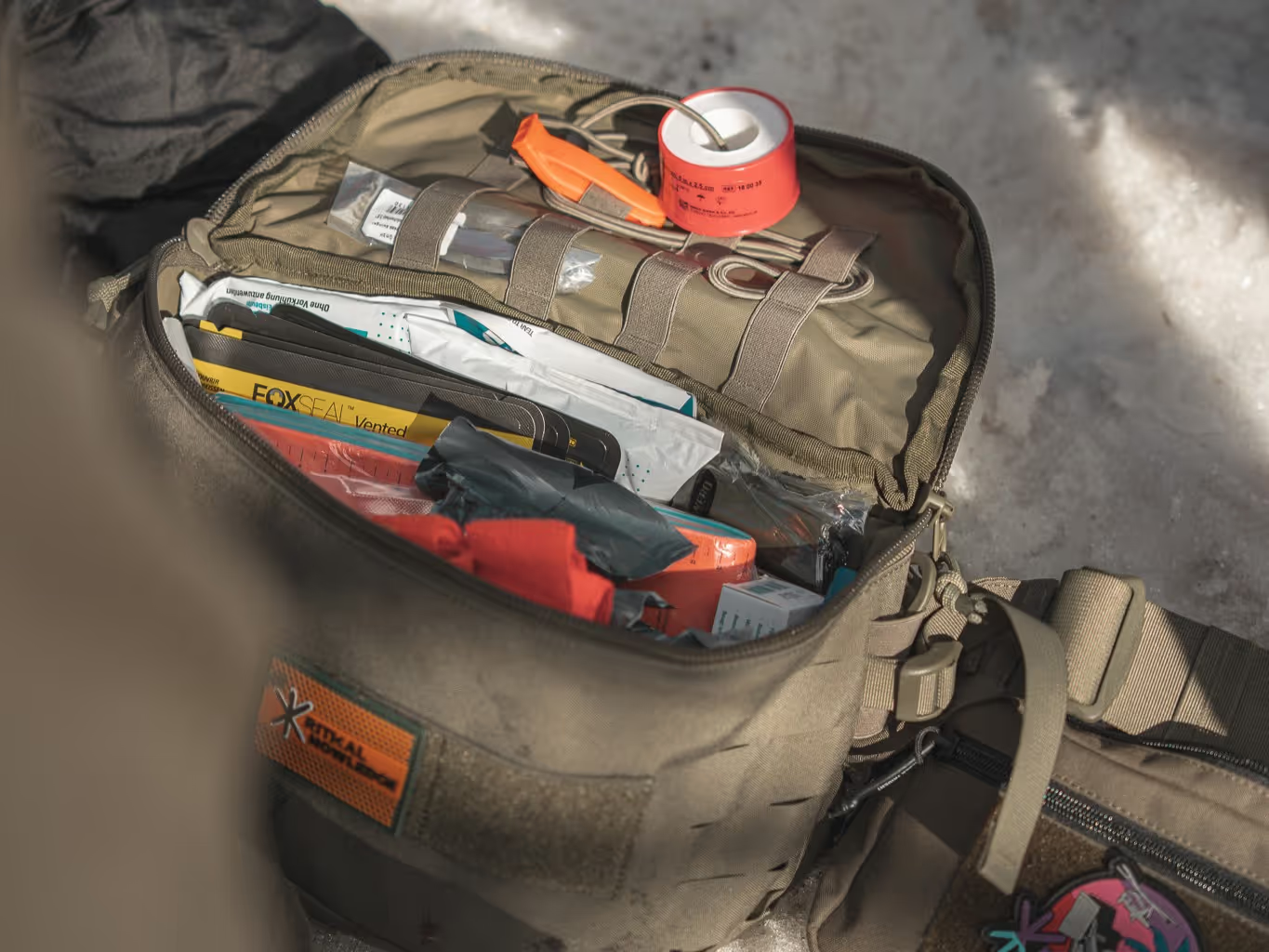
Therefore, first aid in manufacturing facilities must always be combined with self-protection, which, in addition to PPE, can also include specialized trauma kits for life-threatening injuries . First-aid measures must be tailored to the specific risks and accident hazards of the facility. The foundation for this is legally required precautions, such as risk assessments to minimize hazards.
This does not mean doing nothing. It means acting correctly: secure the area, keep your distance, raise the alarm, involve internal specialists, notify the plant fire department or emergency services, provide information on hazardous substances, warn others, and only intervene where it is safely possible.
This should also be practiced.
Because under stress, people quickly resort to impulsive action. People want to help. That is human nature. But good emergency organization ensures that helpers do not become patients themselves.
Scenarios reveal the truth—without exposing anyone
Realistic scenario training is not a test designed to show employees up.
It is a tool to make operational reality visible.
In standard training, almost everyone passes. Everyone gets their certificate. On paper, everything looks perfect. But that says little about whether the chain of rescue actually works in a real-world operation.
A scenario reveals more—especially when it is planned and conducted as a realistic, customized emergency simulation .
Who takes the lead? Who stays calm? Who can handle the sight of blood? Who communicates clearly? Who finds the equipment? Who remembers to call emergency services? Who directs the responders? Who identifies hazards? Who looks after other affected individuals? Who is better suited for a supporting role?
This is not a negative judgment. Not everyone needs to work on the front line with patients. Some employees are excellent at providing instructions. Others organize supplies. Some calm their colleagues down. Some keep track of the big picture. Some lead. Some need extra practice.
For managers, safety officers, and team leaders, this insight is incredibly valuable.
Especially in high-risk areas, it can make sense to plan teams and shifts so that people with higher operational confidence are present by design rather than by chance. This does not replace formal requirements, but it does improve practical resilience.
The goal is not a perfect world.
The goal is an honest picture.
Exercises and first aid courses as part of safety culture
A single training session is good. Regular, realistic exercises are better.
Manufacturing plants should not just describe emergency procedures in theory, but test them repeatedly: evacuation, notification chains, access to materials, casualty care, briefing emergency responders, and cooperation with plant security, the plant fire department, public fire services, emergency medical services, or other organizations.
Such exercises can be conducted openly or partially covertly. In a covert exercise, only the necessary key personnel are informed. This provides a more realistic view of how the organization actually reacts.
The important thing is: such an exercise is not a theatrical performance.
It is a test of operational readiness.
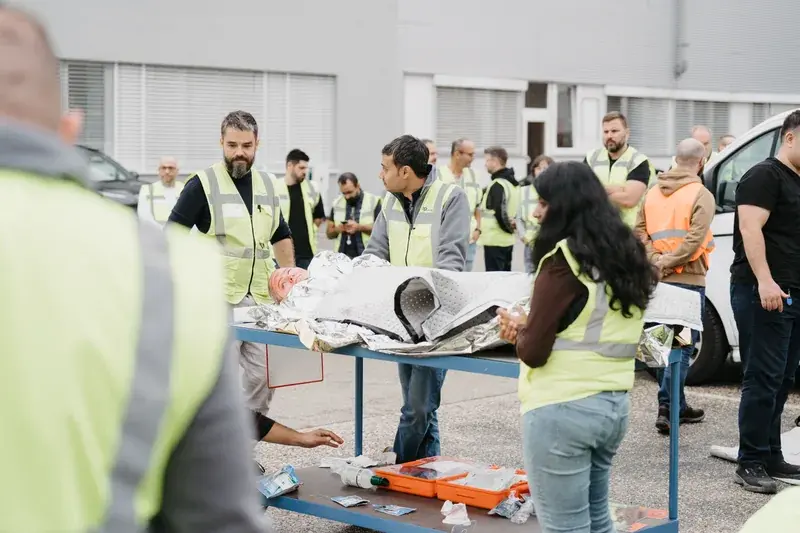
Critical Knowledge can design such safety days, emergency drills, and scenarios: with realistically made-up casualties, briefed actors, appropriate injury patterns, roles, moulage, fake blood, actors, stress factors, and a scenario that fits the facility, supported by specialized training equipment for realistic exercises.
It is not about putting on a show, but about using realistic wound simulation and injury depiction to sharpen perception.
The goal is to simulate an expected situation as realistically as possible and as safely as necessary. After the exercise, the findings are thoroughly evaluated. What worked? What was unclear? Where is equipment missing? Who needs to be informed? Which SOPs need to be adjusted? Which training sessions need more practical application?
This is how an exercise becomes a genuine improvement process.
Teambuilding with a real purpose
Realistic exercises have another benefit: they strengthen teams.
People work together in an unfamiliar situation. They take on roles, communicate, solve problems, help one another, and experience firsthand that safety is more than just a poster on the wall.
It has the character of team building—but with a real purpose.
A well-run exercise can be a positive experience, even if the topic is serious. Participants realize they are capable of achieving something. Managers see their teams in a different light. Safety officers receive concrete feedback. Employees see that their company isn't just checking off mandatory training boxes, but is truly investing in their safety.
That leaves a lasting impression.
Often more so than any PowerPoint presentation.
Why external support makes sense
Internal safety officers know the facility. That is a major advantage. But that is precisely why an external perspective can be so valuable.
Those who work in a facility every day take certain things for granted, whereas an external partner with experience-based first aid and trauma training is more likely to spot blind spots. Paths, gates, shortcuts, equipment locations, responsibilities, and informal processes are logical to internal staff. To external emergency responders, they are not.
An external training and simulation partner can ask questions that are often no longer asked internally. They can design scenarios neutrally, guide participants professionally, simulate realistic injuries, and structure the exercise to generate genuine insights.
For rescue services, fire departments, or plant fire brigades, a realistic simulation can also be valuable. It offers more than just a dry, standard drill; it provides a situational picture that comes closer to real-world conditions: multiple parties involved, operational structures, injury simulation, communication with internal departments, handovers, stress, and debriefing.
Everyone involved benefits when the organization and its employees are also equipped with well-thought-out emergency kits for various areas of operation .
The company. The employees. The safety specialist. The managers. Plant security. The plant fire brigade. External emergency organizations. And, in an emergency, the patient.
What a good exercise should achieve
A good exercise must be tailored to the facility.
It cannot be generic. A scenario in a plastics manufacturing plant looks different from one in a metalworking shop, a food production facility, a chemical lab, a logistics center, or a construction site. The risks, routes, materials, communication channels, and responsibilities all differ.
That is why good practice begins with preparation; this is distinct from statutory first-aid training. For small businesses with up to 4 employees, an 8-hour first-aid course is sufficient, while the 16-hour basic course is a one-time requirement. The exact scope therefore depends on the size of the company, and the first-aid course should be conducted by recognized organizations such as the Red Cross. Corresponding proof should be neatly documented.
Refresher courses for first responders are necessary every 2 to 4 years; the refresher can also be carried out by an occupational physician. Regardless of this, any exercise remains something different from a formal course.
What situation is realistic? Which department is affected? Which people need to be informed? What safety boundaries apply? Which hazards may only be simulated? Which emergency response organizations will be involved? How is it ensured that the exercise itself does not become dangerous? How will the debriefing be conducted? Who will document the lessons learned? How will SOPs be adjusted afterward?
The better this preparation, the greater the benefit.
An exercise should not be maximally chaotic. It should be controlled enough to remain safe and realistic enough to reveal genuine weaknesses.
Conclusion: Scenarios show whether first aid really works
Manufacturing companies need more than just lists of first responders, first-aid kits, and training certificates.
They need a chain of rescue that works in real, everyday life.
That is exactly what is revealed not in a folder, but in a scenario.
That is where it becomes clear whether first responders are sensibly distributed. Whether equipment is found. Whether the AED is known. Whether the reporting chain works. Whether plant security is informed. Whether rescue teams can reach the patient. Whether injured persons can continue to be cared for during evacuations. Whether someone knows who is missing. Whether teams work together under stress. And whether paper plans translate into real operational confidence.
For business owners, safety specialists, HSE managers, plant security, company fire departments, and rescue organizations, this is precisely the added value.
Realistic scenario training does not just show weaknesses.
It shows opportunities for development.
It creates awareness. It strengthens teams. It improves processes. It provides lessons learned. And it brings first aid to where it is needed: into the reality of the workplace.
Our recommendation
If you want to know whether your company's emergency procedures really work: Request scenario training for manufacturing companies
If you would like to organize a safety day with realistic injury simulations and practical first aid: Plan a safety day
If you would like to provide practical training for internal first responders, plant security, or the company fire department: Customized corporate training book
If you would like to conduct a realistic drill together with emergency services, the fire department, or an industrial fire brigade: Discuss operational simulation
Sources and professional classification
Austrian Labor Inspectorate: First aid equipment in workplaces, accessibility, labeling, portability if required, and information on ÖNORM Z 1020.
Austrian Labor Inspectorate: Personnel for fire fighting and evacuation.
DGUV: Occupational first aiders, number, training, and further education.
DGUV Information 204-022: First aid in the workplace, refresher training, operational requirements, and specific hazards.
DGUV Regulation 1 / § 22 Emergency measures: Planning measures for first aid, fire fighting, and evacuation.
VBG / DGUV: Alerting, evacuation, instruction, and support by all employees.
(Word count according to document: approx. 2,976 words)
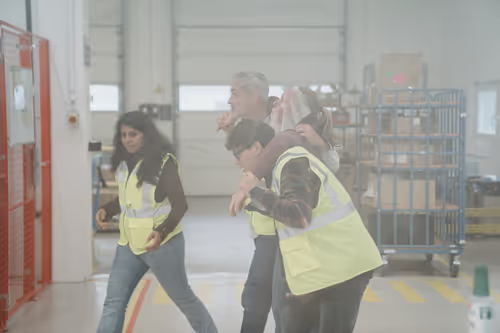
Request a realistic simulation
Transform your emergency training with realistic wound simulations and scenarios to create an intensive and effective learning experience for your team.
Discover our trauma kits
Purchase premium trauma kits, including tourniquets, bandages, and other essential materials for emergencies in challenging environments.
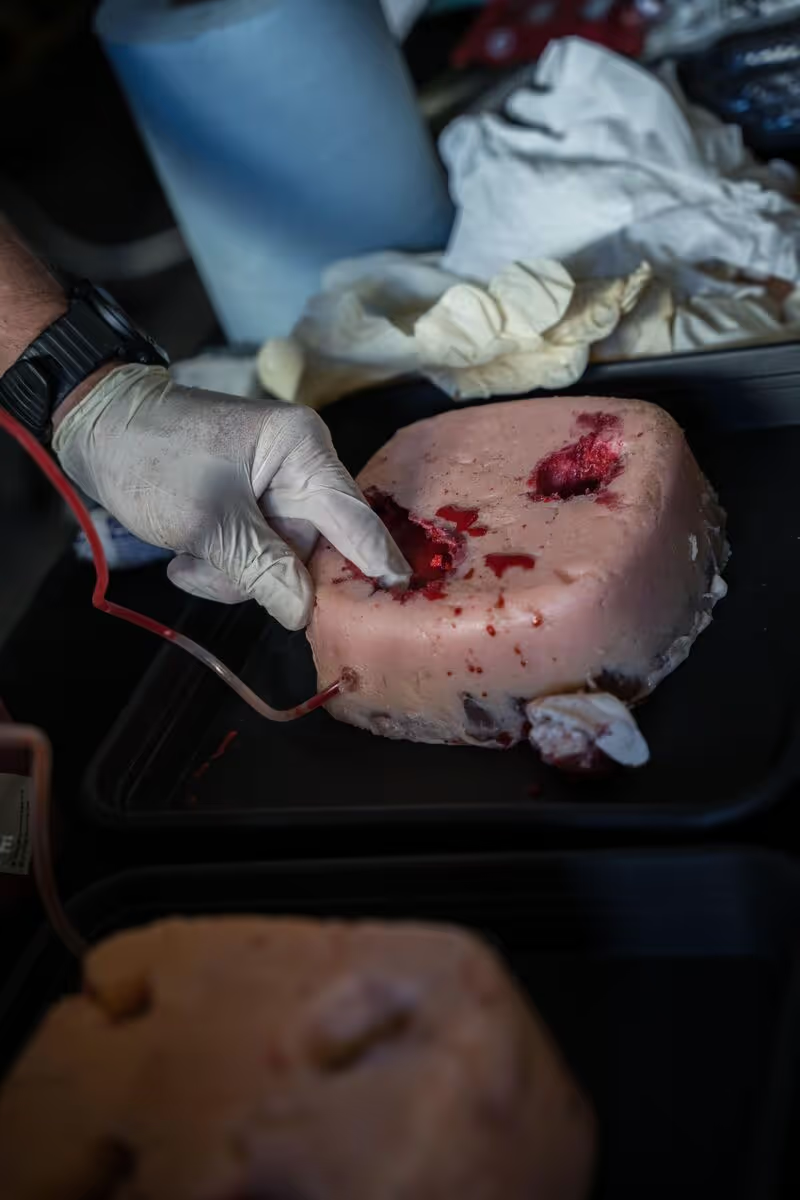
Book your first aid course
Prepare your team for critical situations with hands-on training and real scenarios. Learn how to react quickly in emergencies.

.avif)